“Paris, Lyon, Marseille, Toulon, Bordeaux, Strasbourg, Nantes, Toulouse, Tours. We have looked at most of the major French cities. Is there nowhere to exhibit in Burgundy?”
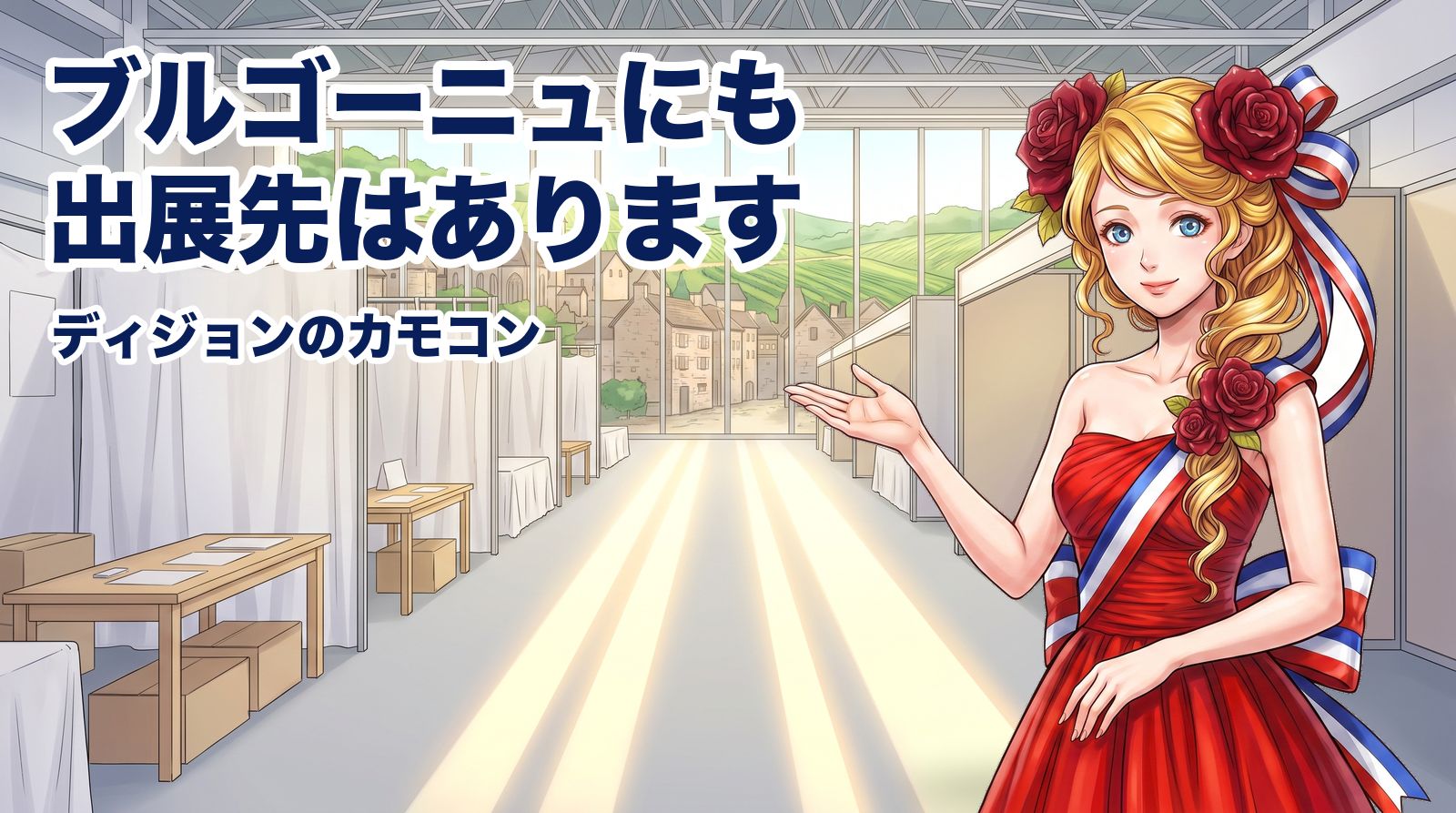
There is. Kamo Con in Dijon. The venue is the Dijon exhibition centre. There is one characteristic we should mention before anything else: the event offers only two entry categories for exhibitors, “creator” and “shop”. A company that cannot decide which badge it will wear stops at the very first step of the application. Below we list only the facts we were able to confirm on the official site.
1. The venue is the Dijon exhibition centre
The venue is the Parc des Expositions de Dijon. The official information page states the following.
- The address is Avenue des Grands Ducs d’Occident
- Visitors enter through Hall 2, Porte des Grands Ducs d’Occident
- Opening hours are 10:00 to 19:00 on Saturday and 10:00 to 18:00 on Sunday
- The 2026 edition was held on 28 and 29 March
This is not a civic hall or a university building borrowed for the weekend. It is a building made for trade fairs. Loading bays and circulation are designed for exhibitions from the start, and power and fittings can be handled through the venue’s own systems. For a company going abroad for the first time, these two points are unglamorous but they make a real difference.
Dijon is the main city of Burgundy. Seen from Paris it lies to the south-east, on the line towards Lyon. It is known for its vineyards and its food, and it is a name Japanese travellers recognise.
2. There are only two exhibitor categories, creator and shop
This is the defining feature of the event. The official exhibitor page lists only these two.
- Creator (Createur)
- Shop (Boutique)
As for who may apply, the organisers write that it is open to amateur artists, experienced artists, craftspeople and shops alike. The design of the event, a gathering for people who make things and people who sell them, is stated plainly in the category names themselves.
If you are used to Japanese trade fairs, having only two categories may look unhelpful. There is no corporate booth, no industry association booth, no municipal allocation. But this is not a lack of care. It expresses the character of the event. This is a place where the person who made the thing stands behind the table.
So the first decision for a company considering this event is not the budget and not the size of the stand. It is whether you enter as someone who makes, or as a shop that sells. Send an enquiry before deciding that, and the organisers have no way to reply.
3. Applications are accepted only by email or through the form
The application route is also stated officially.
- Send an email to the address published on the official site and receive the application documents
- Or submit through the application form on the official site
The organisers add that they process requests made only by email or through the form. Approaching them at the venue, or replying to a social media post, will not be accepted. For an event run by a small team, narrowing the point of contact is a way of protecting the operation. Read that sentence as a courtesy to be observed.
4. Where the organisers publish no figures, we say so
Here is an honest list of what we could not find on the official site.
- The exhibitor fee
- Stand sizes and what the fittings include
- The application deadline
- Visitor numbers and exhibitor numbers
- The date of the next edition
Event listing sites and local press do give visitor figures and future dates. They are not official notices, however, so we do not treat them as figures here. The number of editions held also differs between the official exhibitor page and local reporting. We would rather not present a number whose counting method we cannot verify.
On tickets, the organisers say only that advance tickets are cheaper, and that the standard rate applies from one week before the event and on the day itself. No amount appears on the information page.
The official site also lists events named Kamo Play and Kamo Police alongside Kamo Con. The same organisation runs several events. When you write to them, name the event you mean in the first line and you will avoid crossed wires.
5. How should a company approach an event with only two categories
From here on, this is not the organisers’ published fact but what we have seen on the ground.
We have exhibited at Japan Expo and similar events in France eleven times in total. What we feel every single time is that whether people stop in the aisle is not decided by the accuracy of the text on your panels. It is decided by whether someone who cannot read your language can still follow the story from the pictures alone.
At an event with only creators and shops, that gap widens further. Beside you are people displaying drawings they made themselves. Put a table there carrying nothing but a neatly translated company brochure, and from the aisle it looks like a table nobody can identify. Where there are only two badges, you have to show at a glance which one you are.
Our representative wrote the France chapter of the Digital Content White Paper. That research covered a Japanese local authority that exhibited at Japan Expo in consecutive years, 2012 and 2013. The paper also records why companies stop before results appear. They give up when one appearance produces nothing, and the enthusiasm is not handed on when the person in charge changes. Those two. At a smaller event, the face of a company that keeps coming back is remembered. Turn that around, and judging by a single appearance means losing the part that works best.
Frequently asked questions
Q1. Can a company outside manga and anime exhibit?
The organisers name artists, craftspeople and shops. The sector itself is not restricted. So a company handling crafts or food does have room to enter as a craftsperson or as a shop. The decision rests with the organisers, so the certain route is to write to them naming your products and the category you hope to join.
Q2. How much is the exhibitor fee?
It is not published on the official site, so we will not state a figure. At French events the price changes with the position and size of the stand, so not publishing it is not unusual. Requesting the application documents with your desired size and your product line is the fastest route.
Q3. When is the next edition?
At the time of writing, the official site does not publish the next date. There is only a countdown display. Rather than waiting for the dates before you move, we suggest using the time until they appear to settle one thing internally: whether your company enters as a creator or as a shop.
Q4. Should we choose this or Japan Expo in Paris?
We do not think they compare. Paris is on a different scale entirely, and cost and competition rise with it. Dijon is a regional event with two categories. As a place to test whether your story carries locally, it is in fact an easier size to handle. Please separate the place where you test from the place where you compete.
Q5. What should we bring?
This is a place where makers lay out what is in their own hands. A company brochure heavy with text will be buried by the table next to you. Bring one thing that can be followed from the pictures alone, by someone who does not read your language, and that can be picked up and taken home. Before translation comes the question of whether the pictures carry the story.
One last thing we would like to ask you.
Which badge will your company wear in that aisle, the one who makes or the shop that sells?
Please tell us why you chose it when we speak.
You can see our actual work on manga for overseas audiences. See our international manga work
Where there are only two categories, the table that is neither is the one people walk past.
Related article